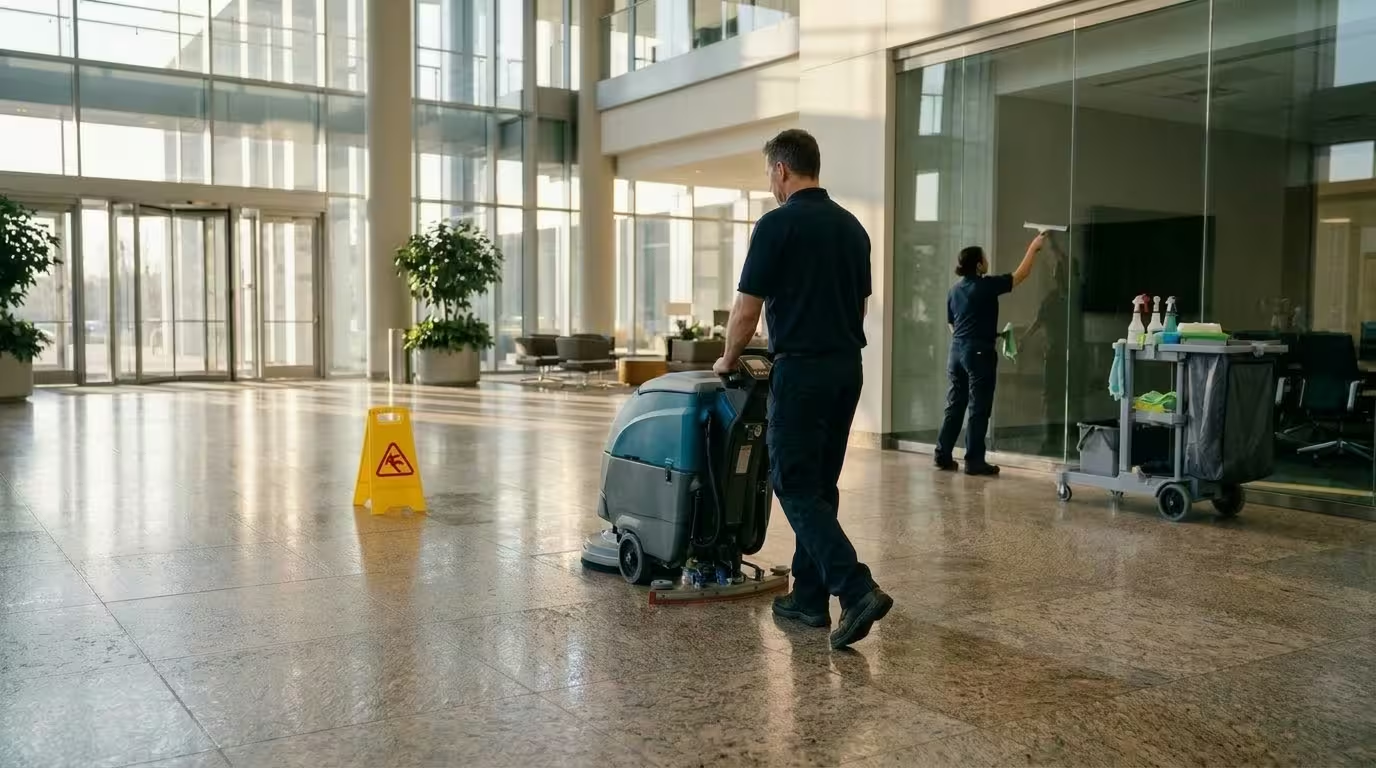
Cleaning & Janitorial Business Insurance protects maid and commercial cleaning crews from client property damage, slip-and-fall claims, and theft. Property managers and building owners routinely require proof of active liability limits and a janitorial bond before handing over keys or access badges.
What Does Cleaning and Janitorial Business Insurance Cover?
A cleaning insurance program pairs third-party liability, employee theft bonding, and crew protection so one accident does not drain operating cash. Because crews work inside occupied offices, medical clinics, and private homes, a single chemical stain or wet-floor fall can trigger a costly claim.
General Liability Insurance: Covers third-party bodily injury and client property damage, such as a visitor slipping on a freshly mopped lobby floor.
Janitorial Bond (Fidelity Bond): Protects clients against proven employee theft of cash, jewelry, electronics, or office equipment during a cleaning job.
Workers' Compensation Insurance: Pays medical bills and partial lost wages when a cleaner suffers a back strain, chemical burn, or ladder fall on duty.
Business Owner's Policy (BOP): Combines general liability with commercial property and business income protection for qualifying cleaning companies.
Commercial Auto Insurance: Covers company vans, wrapped trucks, and employee driving exposure when hauling supplies and equipment between client sites.
Inland Marine Coverage: Insures portable extractors, floor buffers, HEPA vacuums, and pressure washers while in transit or stored at a client building.
Care, Custody, and Control Exclusion: Standard liability forms often exclude damage to items you are actively cleaning unless a broad endorsement is added.
Faulty Workmanship Limits: Liability covers resulting property damage, not the cost to redo a poor cleaning job that failed client inspection.
Chemical and Pollution Exclusions: Harsh stripping agents or mixed bleach fumes can trigger pollution exclusions on standard general liability forms.
Lost Keys and Rekeying Costs: Replacing master keys or rekeying an entire office building often requires a specific lost-key endorsement or sublimit.
Employee Injuries on the Job: Slip-and-fall injuries or chemical exposure suffered by your own W-2 staff belong under workers' compensation, not liability.
Height and Exterior Work Cutoffs: Many standard janitorial carriers restrict exterior window washing above one to three stories unless rated separately.
Most commercial cleaning agreements start with general liability insurance carrying at least $1,000,000 per occurrence and $2,000,000 general aggregate limits. Eligible companies with an office, storage unit, or scheduled supply inventory can often streamline core protection under a Business Owner's Policy.
Simply put: asking whether your quote includes care, custody, and control coverage plus lost-key protection closes two of the most frequent claim gaps in the cleaning trade.
Janitorial Bond vs. General Liability Insurance
General liability pays for accidental injury or property damage to others, while a janitorial bond covers dishonest employee theft from a client. Many property managers ask cleaning vendors to be "insured and bonded," which means carrying both protections rather than treating one as a substitute for the other.
| Coverage Type | Primary Risk Covered | Real Cleaning Claim Example | Common Policy Condition |
| General Liability Insurance |
Accidental third-party bodily injury and property damage |
A tenant slips on an unmarked wet hallway floor or a cleaner cracks a glass conference table |
Excludes intentional employee theft and property under your exclusive care unless endorsed |
| Janitorial Bond (Fidelity Bond) |
Dishonest acts or theft committed by your employees at a client site |
A night crew worker steals laptops or petty cash from an office suite while cleaning after hours |
Many standard forms require an employee conviction unless broader crime wording is used |
| Commercial Auto Insurance |
Bodily injury and property damage caused while driving for business |
A crew van rear-ends another vehicle while heading between two commercial office parks |
Personal auto policies typically exclude regular commercial supply hauling and crew transport |
| Inland Marine (Tools & Equipment) |
Theft or accidental damage to mobile cleaning gear off-site |
Commercial carpet extractors and floor scrubbers are stolen from a locked company van overnight |
Scheduled or blanket tool limits and deductibles vary by carrier form |
When a client contract requires employee dishonesty protection for crews holding building keys or alarm codes, review a dedicated fidelity bond alongside your liability limits. To protect portable floor machines, extractors, and vacuums moving across job sites every day, pair your liability policy with inland marine insurance.
Cleaning Operations We Help Insure
Residential maid services, commercial janitorial firms, and specialty cleaners face different underwriting rules based on building access and equipment. Describing your exact services up front keeps a carrier from disputing a claim over an undisclosed cleaning task.
- Commercial Janitorial Services: Nightly office, retail, school, and warehouse cleaning crews needing contract-compliant limits and keyholder protection.
- Residential Maid and House Cleaning: Solo cleaners and multi-crew home services working around delicate finishes, wood floors, and homeowner belongings.
- Carpet, Upholstery, and Floor Care: Teams operating truck-mounted extractors, buffers, strippers, and waxers with higher water and slip exposure.
- Post-Construction Cleanup Crews: Cleaners removing drywall dust, adhesive, and debris on active or newly finished build sites with contractor COI rules.
- Window and Exterior Cleaning: Ground-level and multi-story glass cleaners facing height restrictions, ladder risks, and surface-scratching claims.
- Medical and Turnover Cleaning: Clinics, dental offices, and short-term rental turnovers requiring strict sanitation protocols and rapid scheduling.
If your crew drives wrapped vans or pays staff to drive personal vehicles between client addresses, add commercial auto insurance or hired and non-owned auto coverage so transit accidents are not excluded. You can also explore how Dream Assurance structures policies across related trades on our insurance by industry page.
Law vs. Contract Requirements and Kansas and Missouri Rules
State laws govern workers' compensation and auto minimums, while property managers and facility owners enforce liability and bonding limits by contract. Knowing which requirements come from state law versus your client agreement keeps you compliant when bidding new accounts.
- Kansas Workers' Comp Law: Under the Kansas Department of Labor (K.S.A. 44-505), payroll over $20,000 requires coverage.
- Missouri Workers' Comp Law: Under the Missouri Department of Labor (RSMo 287.030), non-construction firms with five or more staff need coverage.
- Commercial Client Contract Rules: Office buildings and property managers commonly require $1,000,000 per occurrence general liability and a janitorial bond.
- Additional Insured and Waiver Clauses: Facility contracts often require additional insured status, primary wording, and waiver of subrogation.
Even if your cleaning company falls below a state statutory headcount or payroll threshold, commercial clients and general contractors often refuse to sign a vendor agreement without active workers' compensation insurance. State laws and OSHA chemical-handling rules (29 CFR 1910.1200) vary by operation, and this overview provides insurance coverage guidance rather than legal advice. Once your policies match the contract exhibit, our certificate of insurance team helps verify entity names, limits, and required endorsements cleanly.
How Much Does Cleaning and Janitorial Insurance Cost?
Cleaning insurance cost depends on gross revenue, payroll, service mix, crew size, and whether you clean homes, offices, or post-construction sites. Underwriters price each operation on its actual risk profile rather than a flat rate, so treat any general cost range as planning context, not a quote.
| Underwriting Factor | Why Carriers Price It Closely | Practical Way to Prepare |
| Residential vs. Commercial Mix |
Medical suites, retail lobbies, and 24-hour facilities carry higher foot-traffic and slip exposure than single-family homes |
Break down projected annual revenue by residential, office, retail, and specialty work |
| Annual Revenue and Payroll |
General liability typically rates on gross sales or payroll, while workers' compensation rates directly on W-2 payroll |
Separate owner draws, W-2 cleaner payroll, and any 1099 subcontractor costs clearly |
| Specialty Services and Heights |
Floor waxing, post-construction cleanup, pressure washing, and multi-story window work rate higher than standard dusting |
List every service you perform so underwriters assign accurate class codes up front |
| Bond Limit and Employee Screening |
Higher janitorial bond limits require clear background-check, key-control, and supervision practices |
Document your hiring, background-check, and building-key sign-out procedures |
| Vehicles and Loss History |
Company-owned vans, driver MVRs, and prior slip-and-fall or theft claims directly impact carrier eligibility |
Gather three to five years of loss runs and current driver lists before quoting |
How to Get Cleaning Business Insurance
Dream Assurance reviews your cleaning contracts, declarations page, and service list first, then compares options across multiple carriers. Our team checks care, custody, and control wording, lost-key sublimits, janitorial bond terms, and COI endorsements side by side before coverage is put in place.
Bring your projected annual revenue, employee count and payroll, list of residential or commercial services, equipment values, and any client insurance exhibit when you talk with our team. You can also coordinate cleaning coverage with your broader business insurance program during one review.
Licensed in 30+ States: Dream Assurance serves clients in states where the agency and its producers hold or renew applicable insurance licenses. Coverage availability, carrier access, and policy options may vary by state, coverage type, underwriting requirements, and carrier appointment.
Addisen was a great help for me and helped me understand everything I needed. He also went out of his way to find answers for me. He was very patient and polite.
Andre and Dodge were very professional and offered my a really great rate for my car and insurance.
Addisen did an amazing job getting me and my husband auto insurance for both our vehicles at a competitive rate! Very nice and friendly, he took great care of us and got us insurance ASAP when we were in a bad situation. Highly recommend!
Addison was great he was able to match me with the exact insurance policy that I needed at a cost I can afford!!!
- Ready to compare cleaning business insurance options? Request a quote to review contract exhibits, bond limits, and liability wording.
- Need a broader commercial coverage review? Explore our business insurance options to align liability, workers' comp, auto, and tools.
Frequently Asked Questions
What Insurance Does a Cleaning Business Need?
Most cleaning businesses start with general liability and a janitorial bond, then add workers' compensation, auto, or tool coverage as they grow. Commercial property managers also frequently require a certificate of insurance with additional insured wording before your first shift.
How Much Does Janitorial Insurance Cost?
Janitorial insurance cost varies by revenue, payroll, residential versus commercial work, and specialty tasks, so treat any estimate as planning context. Solo residential cleaners with no employees generally pay less than multi-crew commercial firms carrying workers' compensation, auto, and higher bond limits.
What Is the Difference Between Cleaning Liability Insurance and a Janitorial Bond?
General liability covers accidental injury or client property damage, whereas a janitorial bond covers proven employee theft committed at a client's location. Carrying both satisfies the common "insured and bonded" requirement in commercial office and residential service agreements.
Does General Liability Cover Property My Crew Is Actively Cleaning?
Not always, because standard general liability policies include a care, custody, and control exclusion for property you are directly working on. Adding a broad property damage or care, custody, and control endorsement helps address accidental damage to surfaces, fixtures, or furniture during service.
Do Solo Cleaners or Small Janitorial Crews Need Workers' Compensation?
State law sets mandatory payroll or employee thresholds, yet commercial contracts can still require proof of workers' compensation before you start work. Kansas requires coverage above $20,000 in gross annual payroll under K.S.A. 44-505, while Missouri requires it at five or more employees for non-construction firms under RSMo 287.030.
How Fast Can I Get a Certificate of Insurance for a Commercial Cleaning Contract?
Once your cleaning policy is active and in force, your agent can issue a certificate of insurance showing limits and required contract endorsements. Sharing the property manager's insurance exhibit during quoting prevents last-minute delays over additional insured or waiver of subrogation wording.