Read the certificate field by field
Check the insured, insurer, policy dates, limits, and the certificate holder (the party named to receive the certificate). The walkthrough uses ACORD 25, a standard certificate of liability insurance form.

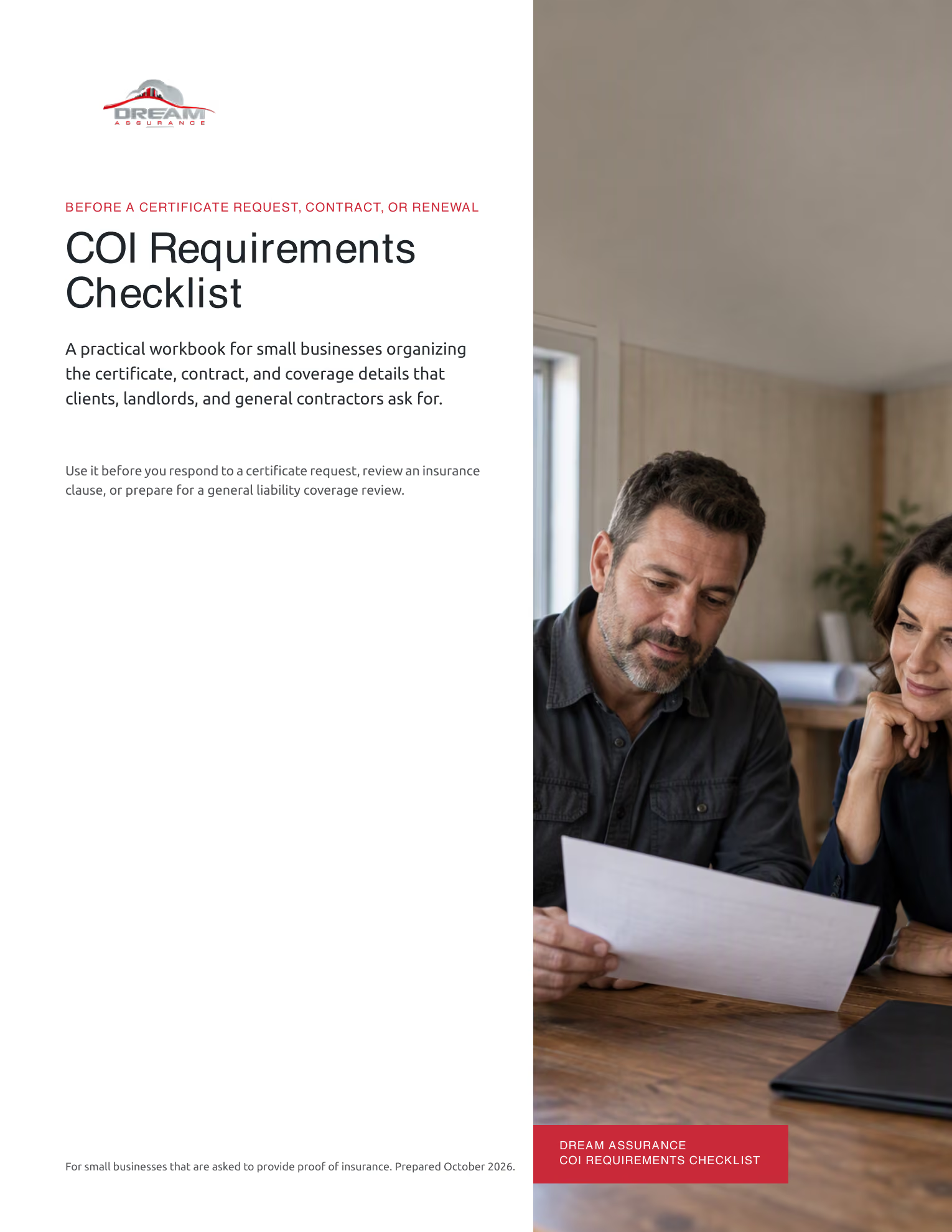
Certificate of insurance workbook
A practical workbook for small businesses that need to decode certificate of insurance (COI) requirements, prepare proof of coverage, and check the certificate, contract wording, and supporting documents before proof is sent.
Need help with a certificate request or the wording behind it? Explore certificate of insurance (COI) for business.
Enter your email to receive the 16-page workbook, printable checklists, and certificate request template.
Your workbook download link appears immediately after a successful submission. A copy is also sent to your email.
By submitting this form, you agree to receive communications from Dream Assurance about this checklist and related insurance services. This workbook is educational and is not an insurance application, policy, contract, legal advice, or coverage determination. Actual coverage depends on the policy form, declarations, endorsements, underwriting, covered events, and facts of a claim.
Inside the workbook
Use the checklist before you respond to a client, landlord, general contractor, vendor, or event venue. It helps you organize the facts, check the documents, and spot wording that needs a closer look.
Check the insured, insurer, policy dates, limits, and the certificate holder (the party named to receive the certificate). The walkthrough uses ACORD 25, a standard certificate of liability insurance form.
Compare the insurance clause with the certificate and the supporting policy documents. A checked box alone does not prove that a requested status or wording is supported.
Gather the legal names, project details, contract clause, limits, holder address, and deadline. Then use the request template, review checklist, and follow-up log.
Before you respond
A certificate request can ask for more than the certificate alone. An endorsement is a document that changes the policy. Use this table to see what to check and which document supports each requirement.
| Requirement | What to verify or provide |
|---|---|
| Legal names and the certificate holder | The named insured matches the policy and contract. The certificate holder has the exact legal name and address. |
| Policy period and limits | The policy dates cover the work, lease, or event. The requested limits and the way the total limit applies per policy, project, or location match the contract. |
| Additional insured status | Another party receives certain protection under your policy. Get the endorsement naming the party and project, not only a checked box. |
| Waiver of subrogation | The contract asks to limit the insurer's right to recover from another party after a payment. Confirm that the policy or an endorsement supports the waiver. |
| Primary and noncontributory wording | The wording addresses which insurance responds first and whether it seeks contribution from other insurance. Ask for the policy wording or endorsement. |
| Completed operations | The request concerns injury or damage tied to finished work. Confirm how the policy and any endorsement treat that work. |
| Separate certificates and certifications | Workers compensation, disability, or a broker certification may require separate forms. Use the forms and instructions the client or state requires. |
A certificate summarizes selected coverage at a point in time. It does not replace the policy or prove that every contract requirement has been met.
Annotated example
The workbook includes an annotated certificate of insurance example with fictitious names and policy details. It shows how the insured, holder, policy period, limits, description of operations, and checked columns should agree.
Fictitious names and policy details. Use the sample to practice reading, not as a template to copy.
| Insured | Northstar Roofing LLC, 1420 Sample Avenue, Overland Park, KS |
|---|---|
| Certificate holder | Cedar Park Property Group, 500 Sample Road, Overland Park, KS |
| Policy period | 01/01/2026 to 01/01/2027 |
| General liability limits | $1,000,000 each occurrence; $2,000,000 general aggregate; $2,000,000 products-completed operations aggregate |
| Description of operations | Cedar Park Property Group is named as additional insured for the Lakeview retail re-roof project. |
General aggregate means the total available for certain payments during the policy period. Products-completed operations refers to certain injury or damage tied to products or finished work.
Who this helps
Use the workbook when a client, contract, lease, project, or renewal asks you to prove coverage or explain what the request means.
Common questions
Use these answers to understand what a certificate request is asking for and what the workbook can help you verify.
Typical COI requirements include the correct legal names, current policy dates, required limits, an exact certificate holder name and address, and any additional insured, waiver of subrogation, primary and noncontributory, or completed-operations wording required by the contract. The contract and policy determine which endorsements or separate certificates are needed.
A certificate holder is the party named to receive the certificate. An additional insured is a party given certain protection under another party's policy through policy wording or an endorsement. Being listed as the holder does not create additional insured status.
A certificate summarizes selected coverage at a point in time; it is not the policy and does not amend or extend coverage. The policy, declarations, and endorsements control. A certificate also does not show whether every contract requirement has been met.
Related guides
Read more about certificates, contract requirements, and the general liability coverage behind the request.
Get help with the request
Bring the contract's insurance clause, the certificate request, and your current policy documents. An agent can compare the requested limits and wording with the policy you have, explain what is already supported, and flag anything that may need a policy change or a coverage review.