
Affordable insurance starts with an easy quote
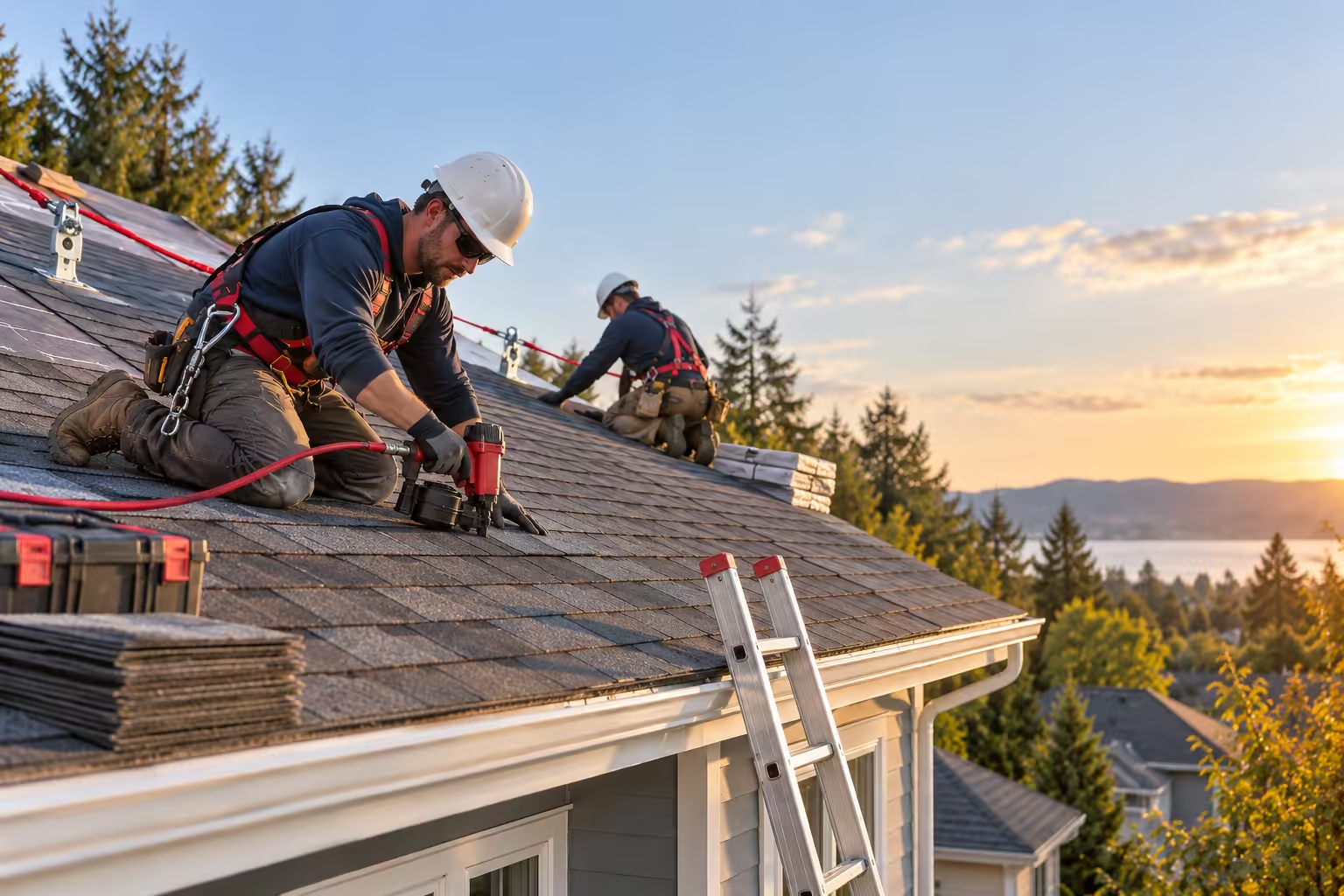
A crew works at height, tears off the old roofing system, and leaves the finished surface exposed to weather. Roofing contractor insurance has to account for the fall risk, the tear-off debris, the finished-work leak, and the contract requirements that come with installation, re-roof, repair, and commercial work.
Roofing business insurance often starts with general liability. There is no single price for roofing insurance. A quote depends on your state, payroll, coverage limits, and the insurance company. Workers' compensation adds more on top, priced for every $100 of payroll. This page covers the coverage review, what affects the cost, workers' compensation, and contract requirements.
For roofing businesses, not homeowners: this page is written for roofing contractors and the companies that employ them. If you are a homeowner trying to understand whether insurance will pay for a roof repair, start with homeowners insurance instead.
Carriers classify roofing differently than most trades, and the difference shows up in what you pay, what carriers ask, and what contracts require. Three factors drive it.
Working at height is the first. According to the Occupational Safety and Health Administration, falls are among the most common causes of serious work-related injuries and deaths, and construction fall protection starts at six feet.
The fatality data shows the risk. The Bureau of Labor Statistics reports that roofing contractors accounted for 26.0 percent of construction fatalities from falls, slips, and trips in 2023, with 110 deaths.
The work itself adds the third. Tear-offs send debris off the roof edge, and water intrusion from an unfinished job may not appear until months later. Finished-work claims are decided by the policy form and the timeline, so carriers price roofing for severity rather than volume.
The coverage conversation starts with how you operate, not with a policy label. Most roofing companies review some combination of the policies below, and none covers everything on its own. If you want to compare property, liability, auto, and workers' compensation coverage, start with the business insurance overview.
General liability covers third-party claims: bodily injury or property damage your work causes to someone else or their property. A roofing example: during a tear-off, debris dents a customer's gutter and cracks a neighbor's window. Many contracts require roofing liability insurance, and clients ask to see it on a certificate. Start with general liability insurance when you review limits and completed operations.
Workers' compensation covers work-related injuries and illnesses for your employees. Given roofing's injury data, it is often the most important line you will price, and it has its own section below.
Commercial auto covers the vehicles your business uses for work: trucks, trailers, and the driving between jobs, suppliers, and dump sites. A roofing example: a loaded trailer in a collision. Business use of personal vehicles often needs hired or non-owned coverage, which applies to vehicles you rent or borrow for business. Review commercial auto insurance for work vehicles with the whole vehicle list.
Inland marine coverage, sometimes called a tools and equipment floater, is designed for movable equipment instead of property at one fixed location. A roofing example: nail guns, compressors, and hoists stolen from a locked trailer overnight, or materials in transit.
Completed operations is the part of liability coverage that answers for work you have already finished. A roofing example: a leak traced to flashing installed months ago. The timing and facts decide how it responds; the workmanship boundary is covered below.
Commercial property covers the shop, the office, stored materials, and business personal property (the contents the company owns). For some roofing businesses, an eligible business owner's policy coverage bundles property and liability in one form.
Umbrella or excess liability adds limits above your underlying policies. Larger commercial projects often require limits higher than a standard policy provides.
The table below is a planning aid, not a substitute for policy wording. Limits come from the policy and the contract, and what an insurer will accept varies by business and state.
| Coverage | What it helps with | Who typically reviews it | Limits to understand |
|---|---|---|---|
| General Liability | Third-party bodily injury and property damage, including completed operations | Most roofing contractors | Contracts often set specific per-occurrence and aggregate limits; confirm the exact limits in the contract and verify the work description |
| Workers' Compensation | Covered work injuries and illnesses for employees | Roofing businesses with employees (requirements vary by state) | Benefits required by state law; priced for every $100 of payroll |
| Commercial Auto | Business vehicles, trailers, and hired or non-owned vehicles (vehicles you rent or borrow for business) | Roofing businesses with owned or leased work vehicles | Liability plus optional physical damage; list every vehicle and driver |
| Tools and Equipment (Inland Marine) | Tools, equipment, and materials in transit or in temporary storage | Crews moving tools between jobs | Scheduled values or blanket limits; check transit and storage terms |
| Commercial Property or BOP (business owner's policy) | Your building, shop, stored materials, and business personal property | Businesses with a location or stored inventory | Replacement cost or actual cash value (what it costs to replace versus what it is worth today); check the BOP eligibility rules |
| Umbrella or Excess | Additional liability limits above underlying policies | Larger jobs and stricter contracts | Required underlying limits must be in place before the excess layer responds |
The fastest way to be disappointed is to assume a policy covers more than it does. These three boundaries cause the most confusion.
Faulty workmanship. The cost of redoing your own defective work is typically excluded. If a crew installs the wrong underlayment and the roof must be reopened, the labor to fix your own mistake usually is not covered. Resulting damage to other property is often treated differently.
Employee injuries. General liability is not the policy for your own employees' work injuries. Workers' compensation and employer obligations cover that side of the risk.
The completed-operations boundary. Coverage for finished work carries its own conditions and timing. When a leak appears long after completion, the response depends on the policy form, when the work was done, and what the contract says.
Every policy also carries exclusions specific to its form and class of work. The coverage review translates those into your operation's language.
There is no single price for a roofing policy. A quote depends on your operation, the coverage limits, the payroll, the state, and the policy terms. Published averages can mislead because a solo owner-operator and a crew of 20 do not buy the same coverage.
Two structural facts sit behind the cost. Roofing is a high-hazard class, so carriers often price it for severity rather than volume. Workers' compensation can be a major line on a roofing invoice.
What moves your number up or down:
If your work includes new construction or projects covered while they are being built, review builders risk insurance. That coverage applies to a project while it is being built, and the structure and pricing are worth reviewing.
Roofing workers' compensation insurance is often a major line for roofing owners, and the coverage with the most moving parts. Understanding the mechanics before the quote saves money and surprises.
Premium is built on a formula that only looks simple. A rate per $100 of payroll is multiplied by the payroll assigned to each employee's class code (the worker classification used to price the risk). Roofing class codes carry high rates because the injury data behind them is severe, and the codes and rates are assigned state by state. The same crew can price differently across state lines because the codes and rates are set by state.
Experience modification is the second lever. An experience modification, often called a mod or EMR, compares your claims history against other businesses in your worker classification. A clean record lowers what you pay. A few expensive claims raise it, sometimes for years, which is why the loss runs at renewal matter.
The third lever is how your crews are paid, and it is where a lot of roofing quotes go wrong. W-2 employees' payroll belongs in your workers' compensation premium. Genuinely independent 1099 contractors with their own coverage are handled through certificates instead. If a crew is misclassified, a premium audit by the insurance company can add those wages to the calculation after the fact.
For the coverage itself, review workers' compensation insurance.
One caution: requirements for carrying workers' compensation vary by state and by workforce. Confirm the rule that applies to your operation.
Many roofing jobs start with a contract that includes insurance requirements. A property owner, general contractor, or lender may ask for proof of coverage before work begins, and the wording matters more than it may seem.
A certificate of insurance is proof that certain coverage was reported when it was issued. It is not the policy itself and cannot change what the policy covers. A contract may ask for additional insured status, a waiver of subrogation, primary and non-contributory wording, or specific limits. Each phrase translates into forms and endorsements:
Before the next job starts, compare the exact request against the actual policy. A certificate holder is not automatically an additional insured, and a note typed onto a certificate cannot create coverage the policy does not provide.
Dream Assurance processes certificate requests through its service-center support. Existing clients can start standard certificate of insurance (COI) requests through the self-service COI portal, and anything unusual should go to the team with the contract attached. For the coverage questions behind a request, start with certificate of insurance support.
A complete starting point helps an agent review your business instead of treating it like a generic account. Bring the following:
Review Business and work details. Legal business name, locations and states where you work, years in business, revenue, and payroll.
Check People and subcontractors. Employee count, job classifications, subcontractor use, written agreements, and certificates collected from other crews.
Bring Vehicles, tools, and property. Vehicle list and drivers, tool and equipment values, rented items, materials in transit, and storage locations.
Review Current insurance and history. Policy declarations (the summary page of your policy), limits, deductibles, endorsements, prior claims, loss runs (your claims history report), and the renewal date.
Check Contract requirements. Client or general contractor specifications, certificate-holder details, requested additional insured wording, waiver language, and deadlines.
Dream Assurance is an independent insurance agency that helps roofing businesses compare coverage options and understand what changes between policies. We compare options from the carriers we represent and walk through the details with you.
Dream Assurance is licensed in 30+ states, and the agency serves clients where it and its producers hold or renew applicable insurance licenses. Coverage availability, carrier access, and policy options may vary by state, coverage type, underwriting requirements, and carrier appointment. To confirm licensing where you operate, check the service areas page.
If you want to talk through the details first, talk with our team and bring your current policy and claims history.
If you work with other trades or project teams, review contractor insurance for the certificate and additional insured requirements they may ask for. Browse business insurance by industry for related trades and services.
Read what clients say about working with Dream Assurance, then ask us to look at how your roof types, height and access, and completed-operations questions shape your coverage.





Roofing coverage is a group of business policies that respond to roofing-specific claims: third-party injury and property damage, employee injuries, business vehicles, tools and equipment, and the property the company owns or stores. The right combination depends on the work you perform and the limits your contracts require.
There is no single price. A quote depends on payroll, revenue, roof type and height, claims history, the limits and deductibles you choose, and the state where you operate. Compare quotes at the same limits and deductibles so the difference reflects coverage, not just price.
Roofing combines work at height, heavy tear-off, and finished-work claims that may appear months later. Insurers price for that severity, and workers' compensation class codes reflect the fall hazard. The quote reflects the work, not just the trade name.
Requirements vary by state and by workforce. Many roofing businesses with employees carry it even where it is not mandatory, because a serious injury can become a claim against the business. Confirm the rule for your state and your crew.
Owners often carry it anyway. One serious fall can change the financial picture quickly, and without workers' compensation an employee injury can become a lawsuit against the business. An agent can compare the cost of coverage with that risk.
W-2 payroll is included in the workers' compensation premium at the class rate. For 1099 crews, the state's independent contractor test, the subcontractor's own coverage, and the certificates they provide all matter. A certificate alone does not settle the worker classification.
General liability is the foundation, not the whole program. It responds to third-party injury and property damage claims, but it does not cover employee injuries, business vehicles, tools and equipment, or the company's own property. Those needs sit under separate policies.
Possibly. Finished-work claims fall under the completed operations part of the policy (coverage after your work is finished), and the policy form, timing, and cause all matter. A leak caused by defective work may be treated differently from damage the leak causes to the building interior.
Timing depends on the request and the policy. Existing clients can start standard certificate requests through the self-service COI portal. Special wording or unusual requirements should go to the team with the contract attached.
New roofing operations can usually find coverage, though the market works differently without a claims history. Pricing reflects that lack of history, and not every insurer accepts a brand-new roofing company. An agent can compare the options that are available.